



Quzhou Hongkang Paper Products Co., Ltd. is a professional manufacturer engaged in the research, development, production, sale and service of paper cup, ice cream cup, soup container, food tray and PS, PET, paper lid. We have more than 100 self-developed designs and molds for you to choose from. We release at least 10 new products monthly to meet the latest market trends.
Paper Cup Size and Shape
Our recyclable paper cups are available in various sizes to carry practically anything. For our personalized wholesale disposable paper cups, we provide a range of patterns, sizes, and forms.
Customization Logo
With the help of our skilled product production team, we can create custom packaging for your company. Imprint your brand on the paper cups to advertise your company.
Design and Printing
We offer your business a variety of designs, whether ready-made stock print designs or products with bespoke printing, thanks to our first-rate design and printing service.
Sustainable Materials
We create, manufacture, and offer a wide selection of environmentally friendly food packaging choices that lessen customer reliance on petroleum-based packaging.


Introduction of Paper Cup
Disposable cups are made by paper with PE/PLA coating. They are usually used to serve drinks and come in two main types: single wall paper cup and double wall paper cup.
Step 1: Submit A Quote Request
The process for custom paper cup development begins with a quote request. You can submit a quote request telling us what you’re looking to have produced and we can then provide you with a quote on how much your custom product order would cost.
Step 2: Send Over Your Design
If the quote looks good to you, the next step will be sending us the custom design you want added to your custom disposables. Ideally, your design will be in an Adobe Illustrator (.ai) or encapsulated postscript (.eps) format, but we can help you convert the file for free if it isn’t. If you don’t have a design created, we can help you create a design at no cost!
Step 3: Review The Proof
Once we have your custom design, we’ll then create a proof for you to review so that you can see what your design will look like on your new custom cups. If you approve of the proof, we’ll then send you an invoice before beginning production.
Step 4: Production & Delivery
Once your invoice is paid, we’ll begin production. We’ll deliver your custom cups straight to you after production. If you don’t have the storage for your whole order, we can store a portion of your order for you until you need it.

Light and Durable
Paper cups are quite durable despite being light. As a result, you can safely carry your beverages and minimize the risk of spills.
Heat Resistant
Paper cups are suitable for both hot and cold beverages due to their heat resistance. Special coatings ensure that hot beverages do not leak outside and protect users' hands from burning.
Versatile Use
Paper cups can be used for coffee, tea, fruit juice, smoothies, and many other beverages. They are also ideal for snacks such as desserts and yogurt.
Customizable
Paper cups can be customized to reflect and promote your brand. By displaying your logo, colors, and designs on the cup, you can increase your brand recognition.
Eco-Friendly
The first and the major benefit of using paper cups is that these are eco-friendly. Basically, these are made up of disposable materials and thus do not cause any harm to the environment. Moreover, as compared to the plastic cups, these can be easily decomposed. It is easy to crumple these cups as well. These cups are made up from natural trees and thus hardly contain any toxic element.
Wide Variety Available
Another reason of its growing popularity is that customers can wide variety of options in the market to choose from. These cups are available in various appealing prints, designs, size, shapes and colors so that one can choose as per their requirements and need.
Safe and Hygienic
Needless to mention, that these paper cups are extremely safe and hygienic to use. These cups are used for one-time purpose and thus prevent infections. Earlier, these are known as health cups as they were introduced to promote public hygiene. They are disposable and thus decrease the chances of catching infections. Manufactured by using paper cup making machine, these are ideal for consuming all kinds of beverages, be it hot or cold.
Light in Weight
Another advantage of using paper cups is that they are light in weight. It can be carried around with much ease and comfort.
Recyclable
Paper cups are recyclable. A pulp is formed with paper and water. This pulp can be further used to make new cups.
Biodegradable
Disposable paper cups are the cleanest products owing to their biodegradable property. Paper is made from trees and thus it usually doesn’t contain any toxic matter.
How are Paper Cups Made?
Making Pulp
After the trees are cut down, they are debarked and then they are made into wood chips and then through a mechanical process the logs are converted into pulp. The pulp is fed into the digester where they will be cooked in a chemical solution at a high temperature in a mix of sodium hydroxide and sodium sulfide.
Beating
This part of the process is where the remaining pulp is put through a pounding and squeezing process. During this step, various filler materials can be added such as chalks, clays, or chemicals such as titanium oxide which these additives will influence the opacity and other qualities of the final product.
Pulp to Paper
The pulp is laid and fed down on the mesh screening where the pulp is being squeezed by a series of rollers to help remove the water from it. After the water is removed and the pulp is squeezed, the paper passes over a series of steam-heated cylinders to help remove the remaining water and after is dried, the paper is wound onto large reels. Paper is smoothed and compacted further by passing through metal rollers called calendars. The paper may be further finished by passing through a vat of sizing material to receive a coating, which can be brushed on or rolled on. This coating could for example be plastic for when making paper cups.
Different Ways to Use Paper Cups
The Obvious Utility
Most of our customers use their paper cups with logos to serve hot drinks such as coffee, tea and hot chocolate. Paper cups are designed for serving hot drinks, and you come across them every single day, whether it’s in 7/11 or in your local supermarket. When buying paper cups for serving hot drinks, you should think about how hot the drinks will be, as single wall paper cups are often not sufficient for high temperatures. Single wall cups can become very hot and almost impossible to hold until the drink starts to cool down. In such cases, you should consider whether double wall paper cups might be more suitable, as they prevent your customers from burning their fingers and help to keep the contents warm.
Cold Drinks
Many of our customers use printed paper cups to serve cold drinks such as juice, water and soft drinks. They have been used for water at orienteering events and for cups of juice given to students with a message. The common theme in such cases is that the paper cups have been used to start up an interaction with other people. If you are going to use the paper cups for cold drinks, then the single wall option is well suited for this. Paper thickness is not all that important when it comes to cold drinks, as the printed cup does not need to preserve heat. Single wall cups offer a simple yet clear expression on the outside and are also a cheap option for serving drinks.
Alcohol and Fat
Some of our customers have used the paper cups to serve alcoholic drinks, such as coffee with Baileys and other similar drinks. You might tend to believe that a simple paper cup can hold almost anything, but there are actually a few things that the simple cup can nonetheless struggle with. Alcohol and fat are a couple of examples. Most paper cups are actually not designed to manage large concentrations of alcohol or fat. This is rarely a problem for alcohol volumes of less than 5 % or for low fat percentages. But anything higher can drastically impact the durability of a standard paper cup. This can be addressed as many manufacturers are able to strengthen the cup material (especially at the bottom) so that they do not begin to leak. Alcohol and fat are not common contents for a paper cup, so remember to ask your paper cup supplier if you want to use your paper cup with logo to serve strong alcoholic drinks or drinks with very high-fat content.
4 Common Types of Paper Materials for Paper Cup


Kraft Paper
As the popular sustainable and most commonly use paper material, kraft paper is ideal for food packaging and catering service. Kraft paper is durable and tear-resistant paperboard. Thus, the kraft paper is perfect for takeout containers and takeaway services. With its natural brown look, it is timeless fashion to use kraft in eco-friendly paper packaging. Virgin Kraft paper is a more eco-friendly paper type. During the kraft paper manufacture process, there are almost no bleached and fewer bleaching chemicals.What is more, the kraft paper is recycled. After it is been recycled, it can be used where there is no requirement on food grade and high tear resistance for example carton box.
Cupstock Paper(White Paper)
Cupstock paper made from renewable resources is a popular solution for food-grade paper material for making paper cups and paper bowls. It has an excellent smooth surface for printing performance. This makes cupstock the best choice for presenting your brand image.The majority of printing paper bowl use cupstock paper. It can be applied both in hot and cold food service:
- One polyethene lamination for hot food(1 pe)
- Two side polyethene laminations for cold food(2 pe)
Besides, due to its smooth surface treatment, Cupstock paper has superior moisture and grease resistance with good lamination.
Bamboo Paper
Bamboo paper is totally different paper material which is made from bamboo plants not from wood pulp. As an Emerging Resource, Bamboo is an important non-Wood Fiber paper raw material. As the bamboo plant grows far much faster than a wood tree (bamboo just needs 3-5 years to reach maturity), bamboo paper is more sustainable and eco-friendlier than kraft and cupstock. Because of its greater tensile strength (higher than steel), Bamboo paper is more tear resistant than wood paper (kraft and cupstock). The bamboo paper bowl is more durable compared to the paper bowl made of other paper materials. It is commonly known that bamboo plants have an anti-bacteria substance called” bamboo Kun”. Because of this property, the bamboo paper is antibacterial and antifungal it can bring a longer shelf life of food in the paper bowl.
Paper Lamination with Aluminium Foil Film
Paper Laminated Aluminum Foil film offers super good durability for paperboard and can handle high-temperature food or beverage, combined with thick paperboard, and PE lamination. The Aluminum Foil layer has A great feature is that Aluminum Foil paper bowl is excellent heat resistant and keeps the hot food or liquid warm for a longer time. Paper Laminated with Aluminum Foil film is also able to maintain takeaway food and beverage well without damage from freezing, taste change or smell change during the delivery to the customer’s hands. It can be applied in many hot food services, including instant noodles, ramen bowls, Spicy hot pots or hot soups. With aluminum foil layer on paper, it can support cooking food in the paper bowl on the induction cooker.
Paperboard
The main raw material used in the production of paper cups is paperboard, which is a type of thick paper that is made from pulped wood fibers. It is characterized by its high strength, stiffness, and resistance to moisture and is specifically designed for use in food packaging applications.
Adhesives
Adhesives are used to hold the layers of paperboard together and create a leak-proof seal. Common adhesives used in the production of paper cups include water-based, solvent-based, and hot-melt adhesives.
Inks
Inks are used to print designs and logos on the surface of paper cups. The inks used must be food-safe and free from toxic substances to ensure that they do not leach into the contents of the cup and pose a health risk.
Coating Agents
Coating agents are used to provide a barrier between the paperboard and the contents of the cup to prevent moisture and other liquids from penetrating the paperboard and causing it to break down. Common coating agents used in paper cup production include wax, PE(polyethylene), and silicone. Disposable paper cups with PE coating materials are the most commonly used on the market at present.
Additives
Additives such as enzymes, emulsifiers, and preservatives are sometimes added to the raw materials to improve the performance and shelf life of the paper cups.
Printing on Paper Cups
Offset Printing
Offset printing is among the most often utilised printing processes for paper cups, particularly when printing in big quantities. The printing plate is the costliest aspect of offset printing. The efficient method also assures reasonable pricing, which will decrease as the volume is increased.
Tampon Print
Tampon printing is comparable to the ‘stamping’ method, in which ink is transferred from an engraved metal plate to a flexible pad, which is then pressed onto the item to be printed.
Flexographic Printing
Flexographic printing is a newer variant of letterpress that can print on nearly any sort of material, like paper, plastics, metals, and even cellophane.
Printing on a Computer
Digital printing, often referred to as “printing,” is one of the most frequent and effective techniques of printing colour images or text onto paper or another substance. Digital printing is increasingly commonly employed in newspapers since it is faster and less expensive when publishing articles with many distinct designs in small numbers.
Quality Control in the Paper Cup Manufacturing Process
Raw Material Quality Control
The journey to top-notch quality begins right with the raw materials. The weight, size, thickness, and safety components of the paper and plastic coating are thoroughly checked. This ensures a sturdy base for manufacturing paper cups and the safety of consumers.
Process Quality Control
As the paper cups transition through printing and cutting, meticulous checks are conducted by us. The printing color and precision of cutting are reviewed, and even the odor of the paper cup is examined. We also perform self-leakage testing, and random samples are taken for further tests. The filled paper cups are exposed to different temperatures, and the ones that pass this phase are undergone microbiological tests.
Finishing Quality Control
As the paper cups are near completion, we will undergo another round of quality checks based on the AQL (Acceptable Quality Level) standards. These checks ensure the cups meet the minimum quality criteria before they are sent off for packing.
Outgoing Quality Control
This final step involves detailed checks on the finished products. Everything from the cup’s appearance to its size, the lid material, the artwork, the weight, and even the packaging and shipping mark is scrutinized. Barcode scanning on packages confirms the identification and tracking. A drop test to check the durability of the product and its packaging caps off the journey.
Our Certificates
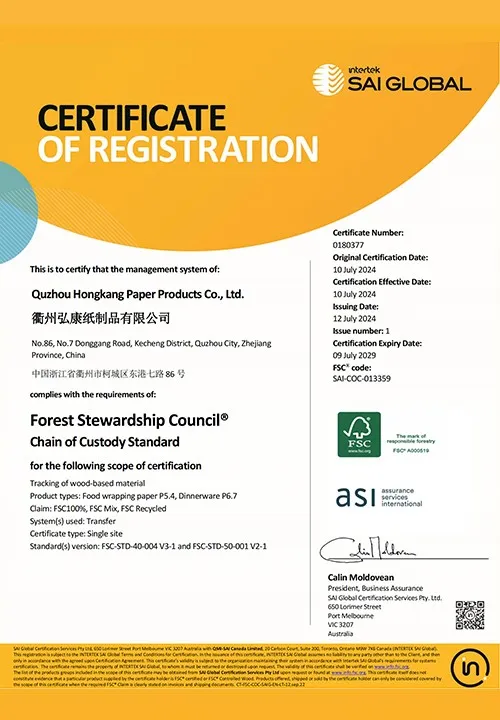
Our company has obtained ISO, SGS, FDA, SedEX, BRC, FSC, QS and other certificates.


Frequently Asked Questions
Q: How paper cups are made?
Paper cups are made from a special grade of paper called ‘cup board’. The board is made from several layers of paper, to keep it stiff and strong even when wet. The board also needs to be supple enough to be rolled into shape. Paper cups feature a ‘mouth roll’, which is a rolled edge around the rim. This not only feels more comfortable for the drinker, but also helps keep the cup rigid and in the correct shape.
The paper cups start life as one large roll of paper. One side is coated with a layer of plastic or wax, which provides a waterproof barrier and becomes the inside of the cup. Then, the rolls are printed with any logos, designs or colours required to feature on the finished product. The rolls is cut into pieces by machine to make individual cups, which are then heat sealed. Circles of paper are also machine cut then heat sealed into place for the bottom of the cup.
Originally, before modern manufacturing methods, paper cups were glued together. To make them last longer, a method had to be found of waterproofing them. This was done by dropping a small amount of clay in the bottom, which was spread up the sides via centrifugal force. Unfortunately, this had the unwanted side effect of tainting the drink, so the process of using a layer of wax or plastic instead was developed, which also helps weld the seams together.
Q: Why are paper cups a sustainable choice?
Tissue
A variety of paper products
Recycled paperboard
They are also a sustainable choice because they are made from a renewable resource, whose cultivation benefits the environment. In other words, they are made with wood fiber from sustainably managed forests, which is a 100% renewable resource.
Q: How to choose raw materials for paper cups?
The highest quality paper cup is made from wood pulp alone, because it contains no other raw materials. Their cost is twice as high compared to the cost of other materials such as sugar cane juice, rice or recycled paper. The cost of the production process is almost negligible in comparison with the price difference between materials.
The use of paper cups is far more environmentally friendly than the use of plastic cups, because it uses recycled waste materials, which are biodegradable. The manufacture of paper cups also produces a small amount of additional waste from the production process that can be used as animal feed.
Q: How to shaping the paper cup?
Q: Are disposable cups biodegradable?
Some people would argue that these alternatives are not as environmental friendly as they seem because paper cups last longer than plastic ones, can be easily recycled and the companies investing in biodegradable plastic cups have been heavily promoted by some environmental groups.
However, it is estimated that the use of paper cups contributes more to greenhouse gas emissions over their lifespan than PET plastic cups because paper requires more energy, water and land to be produced.
Paper cups may be environmentally friendly in the short-term, but over the long-term, their use can contribute to climate change. Paper is made from wood pulp which requires an incredible amount of energy and water to produce it. Additionally, paper cups take up more space in landfills than plastic cups.
Q: Are paper cups safe for hot drinks?
Q: How are paper cups made environmentally friendly?
Q: How are plastic cups made, and are they eco-friendly?
Q: What are the various types of paper used on paper cups?
Normal paper is primarily made from wood which is a renewable source. When a paper is classified as FSC, it means that the paper making process has been certified by FSC. The advantage of FSC paper is that the companies that deal in these certified papers are also certified and follow set rules and principles. FSC 100% label means that the wood raw materials come from well managed and FSC certified forests.
FSC recycled, on the other hand, means all the paper comes from reclaimed or reused material. And FSC mix means that the products are made from a mixture of recycled material and controlled wood.
FSI is the abbreviation for Fibre Sorting, Inc and have been making paper for about three decades now. They produce paper purely from recycled material.
Q: What are paper cups used for?
Q: What category is paper cups?
Q: Why is it better to use paper cups?
Q: Who uses paper cups?
Q: What material is used for paper cups?
Q: Are paper cups eco-friendly?
Q: What is the risk of paper cups?
Q: How do paper cups hold water?
Q: Are paper cups plastic free?
Q: Are paper cups clean?
Q: Are paper cups safer than plastic?
We're well-known as one of the leading paper cup manufacturers in China. Please feel free to wholesale customized paper cup at competitive price from our factory. For pricelist and free sample, contact us now.
Double Layer Paper Cups, Food Paper Tray, Paper Food Box