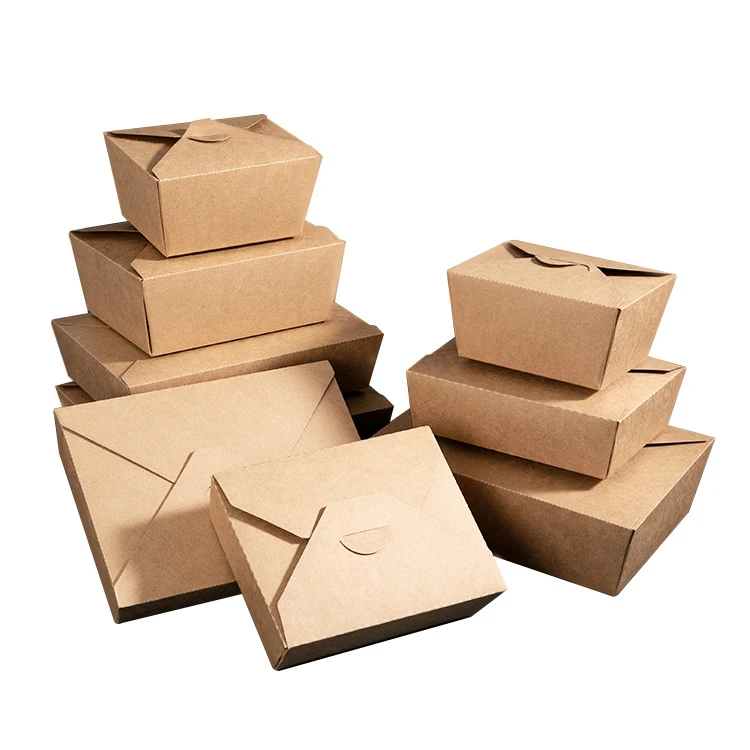
How to Make a Lunch Box
Dec 04, 2025
Leave a message
How to Make a Lunch Box
Stage 1: Design and Pre‑Press
Structural Design
Engineers use CAD software to create a 3D model of the box and a 2D die‑line (flat pattern). The die‑line includes all cut lines, crease lines, and glue tabs, and must be millimeter‑perfect.
Factors considered: product dimensions, weight, stacking strength, shelf appeal, and material efficiency.
Plate and Die Making
Printing Plates: For the artwork, printing plates are made (e.g., aluminum plates for offset, polymer plates for flexo).
Die‑Cutting Forme: A critical tool. A laser cuts the die‑line pattern into a dense plywood board, and then steel blades (for cutting) and steel rules (for creasing) are inserted to create the cutting die.
Stage 2: Printing and Converting (Core Production)
Modern factories often run web‑fed (roll‑to‑roll) or sheet‑fed integrated lines that combine several steps in one flow:
Substrate Feeding
Large rolls or sheets of paperboard (typically SBS – Solid Bleached Sulfate or CUK – Coated Unbleached Kraft) are loaded into the press.
Printing
The paper passes through high‑speed presses. Offset lithography is most common for high‑quality graphics, while flexography is used for larger runs or simpler designs. Multiple printing units apply CMYK and any spot colors.
Surface Finishing (Optional)
To enhance appearance or durability, the printed board may go through:
Varnishing (gloss/matte coating for protection and sheen).
Lamination (applying a thin plastic film).
Foiling / Embossing (for premium effects).
Die‑Cutting and Creasing
This is the heart of box‑making.
The printed and coated board passes through a die‑cutting press.
The custom‑made cutting die (from Stage 1) is mounted in the press.
In one powerful stroke, the die cuts out the box shape and presses precise crease lines into the board, creating the folds.
The output is a flat sheet with multiple box shapes ("net‑shapes") still held together by a skeleton of waste board.
Stripping and Blanking
The sheet goes through a stripping station where the waste skeleton (called "matrix") is removed, leaving only the individual box flats (now called "blanks").
Blanks are automatically stacked and ready for folding.
Stage 3: Folding and Gluing
Automatic Folding and Gluing
Blanks are fed into a folder‑gluer machine at high speed.
The machine picks up each blank and precisely folds it along the pre‑creased lines.
At the appropriate point, a hot‑melt or cold‑glue applicator applies adhesive to the glue tab.
The tab is pressed firmly against the adjacent panel, forming a rigid 3D structure.
The glued box is compressed briefly to ensure bond strength, then ejected.
Quality Control and Inspection
Throughout the process, vision systems and sensors check for:
Print registration defects.
Inaccurate cuts or creases.
Glue application errors.
Structural integrity (via sample compression tests).
Packing and Dispatch
Finished boxes are automatically counted, stacked, and packed into master cartons or on pallets for shipment.
To save space, they are often shipped flat (knocked‑down) to the customer, who erects them as needed.
Key Differences from Handmade Boxes
| Aspect | Factory‑Made | Handmade |
|---|---|---|
| Scale | Thousands to millions per day | One at a time |
| Precision | Laser‑cut dies, micron‑level accuracy | Ruler and eye measurement |
| Material | Engineered paperboard (SBS, CUK) | Decorative/ordinary paper |
| Speed | Hundreds of boxes per minute | Minutes per box |
| Strength | Optimized structure, precise creasing | Variable, depends on skill |
| Cost per Unit | Extremely low due to scale | Relatively high |
Summary
Factory box‑making transforms rolls of paperboard into finished folding cartons through a seamless, automated pipeline:
Design → Print → Coat → Die‑Cut → Fold → Glue → Pack.
This process ensures that every box is identical, strong, and graphics‑ready, meeting the demands of modern retail, food packaging, and e‑commerce logistics.